Some Sundays the lyrics from a great piece of Christian music will be featured. It's not that I want worship to revert to using all hymns, it's just that many modern Christian songs don't SAY anything. I really miss some deeper meaning. So I'm going to remind us of some great words.
Life Is like A Mountain Railroad
M. E. Abbey & Charles Davis Tillman- 1890
the lyrics may have originally been written by a woman, Eliza R.Snow
Life is like a mountain railroad, with an engineer that's brave;
We must make the run successful, from the cradle to the grave;
Watch the curves, the fills, the tunnels; never falter, never quail;
Keep your hand upon the throttle, and your eye upon the rail.
Chorus:
Blessed Savior, Thou wilt guide us,
Till we reach that blissful shore;
Where the angels wait to join us
In Thy praise forevermore.
You will roll up grades of trial; you will cross the bridge of strife;
See that Christ is your Conductor on this lightning train of life;
Always mindful of obstruction, do your duty, never fail;
Keep your hand upon the throttle, and your eye upon the rail.
Chorus
You will often find obstructions; look for storms of wind and rain;
On a fill, or curve, or trestle, they will almost ditch your train;
Put your trust alone in Jesus; never falter, never fail;
Keep your hand upon the throttle, and your eye upon the rail.
Chorus
As you roll across the trestle, spanning Jordan's swelling tide,
You behold the Union Depot into which your train will glide;
There you'll meet the Superintendent, God the Father, God the Son,
With the hearty, joyous, plaudit, "Weary pilgrim, welcome home!"
Chorus
This song is considered corny by those who don't like bluegrass and or trains, and a classic by those who do. I'm in the second group, although I'll be the first to say that there have been a lot of terrible recordings. The music in this video is one of the most popular ever, sung by Patsy Cline. I wanted a video with moving trains, to better illustrate the story. People may think that trains just drive themselves and stay on the rails. Not so, and when trains were the primary mode of long-distance transportation, it was just logical that someone would see the parallel between driving a train and the Christian life.
Sunday, July 31, 2011

Friday, July 22, 2011
General Charles Lee's Legacy
 Major General Charles Lee |
Lee very much wanted to be first in command, thought that he should be, and some other people thought so as well.
I recently read the book The Glorious Cause by Jeff Shaara, author of the better known Gods and Generals. Being something of a Revolutionary War buff, I really enjoyed it. But this is not a book report.
I'll repeat the original question: Do you remember anything about Charles Lee? He was a very important person in the late 18th century. He had much more European military experience than Washington. He was probably the only American general who did. He thought Washington was a poor leader, and wasn't afraid to say so. The early retreats of the Continental army from New York, Brandywine, and across New Jersey to the banks of the Delaware River, across from Trenton, had left Washington looking as if he couldn't win a battle.
Lee sent many letters to the Continental Congress denigrating Washington. He was continually blaming him for the ragged condition of the troops, when this was actually the fault of Congress itself, which body would not send funds for food and uniforms and boots.
 General George Washington |
At the Battle of Monmouth, later, after Lee was released by the British, Washington trusted Lee to lead one of the assaults. Instead, Lee disobeyed direct orders and retreated, leading to the collapse of that entire front. He was later court-martailed. There was some thought that he might have acted treasonously; perhaps he had been turned while a prisoner.
Even after the war, when Washington had proved himself more than able, Lee skulked around trying to get the court-martial overturned, and making disparaging remarks about the hero Commander-In-Chief.
By now, you may be wondering what my point is on a blog about spiritual topics. Let's assume that Lee was actually more qualified militarily than Washington. Now we have the classic modern situation where someone who seemingly deserves a role/position is passed over in favor of someone else. The person not selected can now choose how he or she will respond. Lee spent the rest of his life in bitter and angry strife, trying to tear down the man who had been chosen instead of himself.
And here we are 230+ years later. Do we remember Charles Lee, military strategist and qualified leader? Nope, we remember George Washington, the man who was not only General, but served with integrity, sacrifice, patience, loyalty, and always with humility. It is no accident that we say of him "First in war, first in peace, first in the hearts of his countrymen."
Although there is some debate as to whether Washington was a Christian, or only a Deist, he certainly lived his life by Christian principles. Lee did not. Which one is your hero? Which one is mine?
Friday, June 24, 2011
Was Jesus an Iconoclast?
 |
Huh? OK, it may have been a while since you had a basic philosophy course, so just as a reminder, an iconoclast is someone who delights in breaking down (clast) traditional symbols (icon). This usually refers to political or religious symbols. It began as a literal reference to destroying the monuments or idols of a country that was conquered. A recent example is the pulling down of the statue of Saddam Hussein in Baghdad.
Jesus certainly did some iconoclastic things. He told the Jewish leaders that man was not made for the Sabbath, but the Sabbath for man, and proceeded to heal people on that sacred day.
He overturned the tables of the money changers, and claimed that he would destroy the temple. We now interpret this as a reference to his crucifixion, but those who first heard him thought he meant it literally. He called the ruling spiritual class whitewashed graves, and warned them that they needed to clean up the mess on the inside instead.
The term iconoclast has evolved to mean anyone who throws out traditional norms and imagery, basically someone who thinks way outside the box. In modern thought, sometimes an iconoclast really has no good idea of what might replace the old ideas or icons, but simply wants change in whatever form it may take.
Jesus was certainly not seeking change for its sake alone. He had a plan, a plan that had been set in motion by God the Father long before Jesus came to Earth.
Did he want to tear down the old idols? He clearly wanted to rid the Jewish religion of the “forms of righteousness” and replace them with the real thing. He challenged the orthodoxy of the day.
On the other hand, Jesus said that he did not come to destroy the law, but to fulfill it. That doesn’t sound like someone who wants to throw out all old standards or imagery. Instead, he often quizzed people about what the law really meant, and boiled it down to its two key elements, “love the Lord your God with all your heart, and love your neighbor as yourself.”
Was Jesus an iconoclast? I guess it depends on how you want to define the term. He brought sweeping reform, from an authoritative source, but not simply for the sake of undirected change. His “reforms” of the old ways of thinking, and of approaching God, changed the world forever.
Tuesday, May 10, 2011
As Weak as a Sunday School
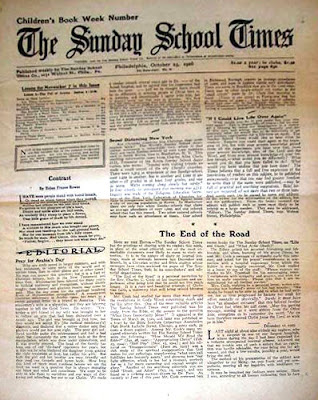 |
I have been re-reading the Christian classic In His Steps, by Charles Sheldon (1897). It was certainly one of the most influential books read in my high school years, and resulted in my choosing I Peter 2:21 as my life verse: "Christ suffered for you, leaving you an example, that you should follow in his steps."
In the book, one man who takes the challenge to always ask "What would Jesus do?" is a newspaper owner, who begins to transform his powerful paper into a Christian one. Of course he loses prestige, and money. As he recounts changes made after a few months he says, "Some say I will have a weak, namby-pamby Sunday School sheet. If I get out something as good as a Sunday-school it will be pretty good." He goes on to make a generalization that the Sunday school movement accomplished a lot of good, and wasn't weak at all.
I got to thinking about this, because many Christian endeavors are often characterized as weak, because they are genuinely meek instead. But I'm going to stick to the topic here of Sunday School. What has this movement really accomplished?
Its founding is credited to Robert Raikes and Thomas Stock in Gloucester, UK in 1780. It was established to educate and help children of the working poor, and was met with considerable criticism from those who didn't think the masses should be educated.
Facts
• Early on, it provided both spiritual and academic instruction, helping poor children prepare themselves for some life other than that of crime or hard labor.
• There is some evidence for Sunday Schools in America as early as the late 1600s.
• In 1824 the American Sunday School Union was formed and many schools were established. A notable example was the work of Stephen Paxon who founded 1314 schools in rural areas many of which grew into churches as the children matured.
Effects
• Children WERE educated. Remember that before 1870 children were not required to attend school in the United States.
• By 1889 American Sunday schools were performing the role of public education for 10 million children, sponsored and paid for by Christians
• some Marxist historians have credited 19th-century Sunday schools with empowering the working classes.
• Certainly SS classes have created generations of Christians with knowledge of the Bible. Consider that 500 years ago most people had never read a Bible passage for themselves.
• Sunday school provided a bright spot in the week when life, even for children, was usually dull and filled with work. Small toys, prizes, and interesting reading materials were coveted.
• Sunday School libraries often brought greater literacy to entire towns.
Sunday schools have fallen on hard times for a number of reasons, which are not the focus of this article.
The point is, if anything we can accomplish is as weak as Sunday School, we should be immensely satisfied, and certain that God has been glorified.
Tuesday, April 19, 2011
Today is an Empty Box
 |
Talk about a message falling from the sky! You might think that I posed this picture, or doctored it, but I didn't. It literally fell from the sky.
A couple of days ago the winds were howling across our county- gusts up to 45 mph. The dog and I took a short walk anyway. Quite a lot of trash was sailing around our property, empty topsoil bags from somewhere, and other assorted scraps. One of them was this box.
This message is pretty trite, but the delivery was so unique that I was forced to pay attention.
Yes, today IS an empty box. Each of us is given a brand new chance, every morning, to fill our box with... good things, positive things, helpful things... or negativity, degrading images, laziness, hurtful things. We DO get to choose what we will put in that box.
If we fill it with garbage, the box will hide it for a while, until the odors seep into the cardboard and the whole box begins to stink, our "secret" will be out. If we fill it with fresh flowers, the beautiful scent will accompany us on our daily rounds.
If we put things in the box that don't belong there- perhaps some slimy mud, before long the box will begin to sag and lose its structure... its health. If we fill it with the kinds of things a box was designed to hold, it will serve us for many days.
If we think that we can ignore the box and put nothing in it, we have even made a choice. Before long, spiders and cockroaches and moths will come and begin to degrade the box until it's no longer useful.
What will I put in my box today? How about you?
Philippians 4:8
Finally, brothers and sisters, whatever is true, whatever is noble, whatever is right, whatever is pure, whatever is lovely, whatever is admirable—if anything is excellent or praiseworthy—think about such things.
Proverbs 23:7
for as [a person] thinks within himself, so he is
Sunday, April 3, 2011
Lyrics- Hiding Place
Every Sunday the lyrics from some great piece of Christian music will be featured. It's not that I want worship to revert to using all hymns, it's just that many modern Christian songs don't SAY anything. I really miss some deeper meaning. So I'm going to remind us of some great words.
Hiding Place
Jerry Dean Salley, Jr, Steven Curtis Chapman
In the distance I can see the storm clouds coming my way
And I need to find a shelter before it starts to rain
So I turn and run to You Lord, You're the only place to go
Where unfailing love surrounds me when I need it most.
Chorus:
You're my hiding place, safe in Your embrace
I'm protected from the storm that rages
When the waters rise, and I run to hide
Lord, in You I find my hiding place.
I'm not asking you to take away my troubles, Lord
'Cause it's through the stormy weather I learn to trust You more
And I thank You for Your promise I have come to know
Your unfailing love surrounds me when I need it most.
Chorus
So let your people seek You
While You may be found
'Cause You're our only refuge
When the rain comes pouring down
Chorus
This is attributed to Jerry Dean Salley, Jr and Steven Curtis Chapman with a date of 1997, but I learned the chorus in about 1988, so I don't know if the verses were added later. There is a very popular song with similar lyrics "You Are My Hiding Place" which seems to be the only one that videos were made for. I found exactly one video with this song, and it has no visuals except for the album cover. Just close your eyes and listen. This song became one of those that helped to hold us together through a very difficult time.
Monday, December 20, 2010
The Hound of Heaven
 Francis Thompson |
This post isn't going to be for everyone. Not many people will have the fortitude to read this entire poem, I'm pretty sure. But I was raised on a lot of famous poetry, and some phrases of this poem have been "hounding" me this fall.
I've been trying to deal with a big disappointment, where I believe that I was seriously wronged. To the point where I have considered taking legal action if I thought I could prove anything. Of course, this isn't the kind of person I want to be. I'm just trying to convey how upset and angry I've been.
Although this poem was written with the idea of God chasing down someone who has turned away from Him, it still resonates. Every time I felt so angry, I also felt that God's principles- the ones I want to live by- have been chasing me. For example:
From those strong Feet that followed, followed after.
But with unhurrying chase,
And unperturbèd pace,
Deliberate speed, majestic instancy,
They beat--and a Voice beat
More instant than the Feet--
"All things betray thee, who betrayest Me."
and
And now my heart is a broken fount,
Wherein tear-drippings stagnate, spilt down ever
From the dank thoughts that shiver
Upon the sighful branches of my mind.
Such is; what is to be?
So, I present to you the entire poem, The Hound of Heaven, by Francis Thompson, 1893. Read on, if you are brave:
I fled Him, down the nights and down the days;
I fled Him, down the arches of the years;
I fled Him, down the labyrinthine ways
Of my own mind; and in the mist of tears
I hid from Him, and under running laughter.
Up vistaed hopes I sped;
And shot, precipitated,
Adown Titanic glooms of chasmed fears,
From those strong Feet that followed, followed after.
But with unhurrying chase,
And unperturbèd pace,
Deliberate speed, majestic instancy,
They beat--and a Voice beat
More instant than the Feet--
"All things betray thee, who betrayest Me."
I pleaded, outlaw-wise,
By many a hearted casement, curtained red,
Trellised with intertwining charities
(For, though I knew His love Who followed,
Yet was I sore adread
Lest having Him, I must have naught beside);
But if one little casement parted wide,
The gust of His approach would clash it to.
Fear wist not to evade, as Love wist to pursue.
Across the margent of the world I fled,
And troubled the gold gateways of the stars,
Smiting for shelter on their clanged bars;
Fretted to dulcet jars
And silvern chatter the pale ports o' the moon.
I said to dawn, Be sudden; to eve, Be soon;
With thy young skyey blossoms heap me over
From this tremendous Lover!
Float thy vague veil about me, lest He see!
I tempted all His servitors, but to find
My own betrayal in their constancy,
In faith to Him their fickleness to me,
Their traitorous trueness, and their loyal deceit.
To all swift things for swiftness did I sue;
Clung to the whistling mane of every wind.
But whether they swept, smoothly fleet,
The long savannahs of the blue;
Or whether, Thunder-driven,
They clanged his chariot 'thwart a heaven
Plashy with flying lightnings round the spurn o' their feet--
Still with unhurrying chase,
And unperturbèd pace,
Deliberate speed, majestic instancy,
Came on the following Feet,
And a Voice above their beat--
"Naught shelters thee, who wilt not shelter Me."
I sought no more that after which I strayed
In face of man or maid;
But still within the little children's eyes
Seems something, something that replies;
They at least are for me, surely for me!
I turned me to them very wistfully;
But, just as their young eyes grew sudden fair
With dawning answers there,
Their angel plucked them from me by the hair.
"Come then, ye other children, Nature's--share
With me," said I, "your delicate fellowship;
Let me greet you lip to lip,
Let me twine with you caresses,
Wantoning
With our Lady-Mother's vagrant tresses'
Banqueting
With her in her wind-walled palace,
Underneath her azured daïs,
Quaffing, as your taintless way is,
From a chalice
Lucent-weeping out of the dayspring."
So it was done;
I in their delicate fellowship was one--
Drew the bolt of Nature's secrecies.
I knew all the swift importings
On the wilful face of skies;
I knew how the clouds arise
Spumèd of the wild sea-snortings;
All that's born or dies
Rose and drooped with--made them shapers
Of mine own moods, or wailful or divine--
With them joyed and was bereaven.
I was heavy with the even,
When she lit her glimmering tapers
Round the day's dead sanctities.
I laughed in the morning's eyes.
I triumphed and I saddened with all weather,
Heaven and I wept together,
And its sweet tears were salt with mortal mine;
Against the red throb of its sunset-heart
I laid my own to beat,
And share commingling heat;
But not by that, by that, was eased my human smart.
In vain my tears were wet on Heaven's gray cheek.
For ah! we know not what each other says,
These things and I; in sound I speak--
Their sound is but their stir, they speak by silences.
Nature, poor stepdame, cannot slake my drouth;
Let her, if she would owe me,
Drop yon blue bosom-veil of sky, and show me
The breasts of her tenderness;
Never did any milk of hers once bless
My thirsting mouth.
Nigh and nigh draws the chase,
With unperturbèd pace,
Deliberate speed, majestic instancy;
And past those noisèd Feet
A voice comes yet more fleet--
"Lo naught contents thee, who content'st not Me."
Naked I wait Thy love's uplifted stroke!
My harness piece by piece Thou hast hewn from me,
And smitten me to my knee;
I am defenseless utterly.
I slept, methinks, and woke,
And, slowly gazing, find me stripped in sleep.
In the rash lustihead of my young powers,
I shook the pillaring hours
And pulled my life upon me; grimed with smears,
I stand amid the dust o' the mounded years--
My mangled youth lies dead beneath the heap.
My days have crackled and gone up in smoke,
Have puffed and burst as sun-starts on a stream.
Yea, faileth now even dream
The dreamer, and the lute the lutanist;
Even the linked fantasies, in whose blossomy twist
I swung the earth a trinket at my wrist,
Are yielding; cords of all too weak account
For earth with heavy griefs so overplussed.
Ah! is Thy love indeed
A weed, albeit amaranthine weed,
Suffering no flowers except its own to mount?
Ah! must--
Designer infinite!--
Ah! must Thou char the wood ere Thou canst limn with it?
My freshness spent its wavering shower i' the dust;
And now my heart is a broken fount,
Wherein tear-drippings stagnate, spilt down ever
From the dank thoughts that shiver
Upon the sighful branches of my mind.
Such is; what is to be?
The pulp so bitter, how shall taste the rind?
I dimly guess what Time in mist confounds;
Yet ever and anon a trumpet sounds
From the hid battlements of Eternity;
Those shaken mists a space unsettle, then
Round the half-glimpsed turrets slowly wash again.
But not ere him who summoneth
I first have seen, enwound
With blooming robes, purpureal, cypress-crowned;
is name I know, and what his trumpet saith.
Whether man's heart or life it be which yields
Thee harvest, must Thy harvest fields
Be dunged with rotten death?
Now of that long pursuit
Comes on at hand the bruit;
That Voice is round me like a bursting sea:
"And is thy earth so marred,
Shattered in shard on shard?
Lo, all things fly thee, for thou fliest Me!
Strange, piteous, futile thing,
Wherefore should any set thee love apart?
Seeing none but I makes much of naught," He said,
"And human love needs human meriting,
How hast thou merited--
Of all man's clotted clay rhe dingiest clot?
Alack, thou knowest not
How little worthy of any love thou art!
Whom wilt thou find to love ignoble thee
Save Me, save only Me?
All which I took from thee I did but take,
Not for thy harms.
But just that thou might'st seek it in my arms.
All which thy child's mistake
Fancies as lost, I have stored for thee at home;
Rise, clasp My hand, and come!"
Halts by me that footfall;
Is my gloom, after all,
Shade of His hand, outstreched caressingly?
"Ah, fondest, blindest, weakest,
I am He Whom thou seekest!
Thou dravest love from thee, who dravest Me."
Subscribe to:
Posts (Atom)