Notice: I've taken a part-time job, and it's definitely affecting my blogging time. I'll continue to add content here as often as possible.
Showing posts with label philosophy. Show all posts

Friday, June 24, 2011

Was Jesus an Iconoclast?

revolution uprising

Huh? OK, it may have been a while since you had a basic philosophy course, so just as a reminder, an iconoclast is someone who delights in breaking down (clast) traditional symbols (icon). This usually refers to political or religious symbols. It began as a literal reference to destroying the monuments or idols of a country that was conquered. A recent example is the pulling down of the statue of Saddam Hussein in Baghdad.

Jesus certainly did some iconoclastic things. He told the Jewish leaders that man was not made for the Sabbath, but the Sabbath for man, and proceeded to heal people on that sacred day.

He overturned the tables of the money changers, and claimed that he would destroy the temple. We now interpret this as a reference to his crucifixion, but those who first heard him thought he meant it literally. He called the ruling spiritual class whitewashed graves, and warned them that they needed to clean up the mess on the inside instead.

The term iconoclast has evolved to mean anyone who throws out traditional norms and imagery, basically someone who thinks way outside the box. In modern thought, sometimes an iconoclast really has no good idea of what might replace the old ideas or icons, but simply wants change in whatever form it may take.

Jesus was certainly not seeking change for its sake alone. He had a plan, a plan that had been set in motion by God the Father long before Jesus came to Earth.

Did he want to tear down the old idols? He clearly wanted to rid the Jewish religion of the “forms of righteousness” and replace them with the real thing. He challenged the orthodoxy of the day.

On the other hand, Jesus said that he did not come to destroy the law, but to fulfill it. That doesn’t sound like someone who wants to throw out all old standards or imagery. Instead, he often quizzed people about what the law really meant, and boiled it down to its two key elements, “love the Lord your God with all your heart, and love your neighbor as yourself.”

Was Jesus an iconoclast? I guess it depends on how you want to define the term. He brought sweeping reform, from an authoritative source, but not simply for the sake of undirected change. His “reforms” of the old ways of thinking, and of approaching God, changed the world forever.

Tuesday, May 10, 2011

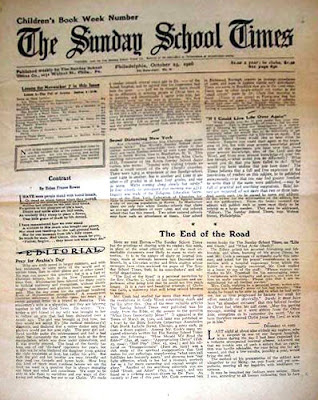
As Weak as a Sunday School


1926 Sunday School Paper

I have been re-reading the Christian classic In His Steps, by Charles Sheldon (1897). It was certainly one of the most influential books read in my high school years, and resulted in my choosing I Peter 2:21 as my life verse: "Christ suffered for you, leaving you an example, that you should follow in his steps."

In the book, one man who takes the challenge to always ask "What would Jesus do?" is a newspaper owner, who begins to transform his powerful paper into a Christian one. Of course he loses prestige, and money. As he recounts changes made after a few months he says, "Some say I will have a weak, namby-pamby Sunday School sheet. If I get out something as good as a Sunday-school it will be pretty good." He goes on to make a generalization that the Sunday school movement accomplished a lot of good, and wasn't weak at all.

I got to thinking about this, because many Christian endeavors are often characterized as weak, because they are genuinely meek instead. But I'm going to stick to the topic here of Sunday School. What has this movement really accomplished?

Its founding is credited to Robert Raikes and Thomas Stock in Gloucester, UK in 1780. It was established to educate and help children of the working poor, and was met with considerable criticism from those who didn't think the masses should be educated.

Facts
• Early on, it provided both spiritual and academic instruction, helping poor children prepare themselves for some life other than that of crime or hard labor.
• There is some evidence for Sunday Schools in America as early as the late 1600s.
• In 1824 the American Sunday School Union was formed and many schools were established. A notable example was the work of Stephen Paxon who founded 1314 schools in rural areas many of which grew into churches as the children matured.

Effects
• Children WERE educated. Remember that before 1870 children were not required to attend school in the United States.
• By 1889 American Sunday schools were performing the role of public education for 10 million children, sponsored and paid for by Christians
• some Marxist historians have credited 19th-century Sunday schools with empowering the working classes.
• Certainly SS classes have created generations of Christians with knowledge of the Bible. Consider that 500 years ago most people had never read a Bible passage for themselves.
• Sunday school provided a bright spot in the week when life, even for children, was usually dull and filled with work. Small toys, prizes, and interesting reading materials were coveted.
• Sunday School libraries often brought greater literacy to entire towns.

Sunday schools have fallen on hard times for a number of reasons, which are not the focus of this article.

The point is, if anything we can accomplish is as weak as Sunday School, we should be immensely satisfied, and certain that God has been glorified.

Monday, October 25, 2010

Off the Wall- Relics and Miracles


woman with an issue of blood

How many people believe in healings? How many people believe that someone could be healed just by touching something that belonged to a highly spiritual person, a relic? It all seems pretty hokey, doesn’t it?

I’m frankly uncomfortable with “faith healers.” When I was ten years old, our family vacationed in Quebec. We visited St. Anne DeBeaupre, and watched a long line of people waiting to enter the church, hoping to be cured of various ills. I gazed, somewhat scornfully, at thousands of framed coins which had passed harmlessly through the digestive tracts of an equal number of people, with the escapes from death attributed to St. Anne. I had a harder time accounting for displays of crutches left behind, but even then, I wasn’t buying that modern-day miracle stuff.

Now, I’m way past ten years old, my faith in a God who can heal is secure, but I still wonder about the veracity of a number of claims associated with relics.

Throughout Christian history, items which belonged to, or were associated with “saints,” have been venerated. The official definition of “venerated,” is that the relics are valued because they cause us to better “adore him whose martyrs they are” (Saint Jerome). It’s become something of a joke... if all the purported pieces of the cross of Christ were assembled, they would make plenty of crosses. In the 16th century, Erasmus wrote: “There was so much wood from the cross, Christ must have been crucified on a whole forest.”

But, when you put the silliness of humans aside, in their intense desires to experience something better, or even something thrilling, what’s left?

Surprisingly, what’s left are several Scriptural references to miracles associated with relics.

The best known is certainly the instance when the unclean woman touched Jesus robe and was healed. Despite the fact that Jesus was in a crowd, surrounded by people who were probably touching him, he recognized that power had gone out from him, to accomplish this healing. Jesus did, in reality, make his clothing holy! OK, that’s Jesus... he’s a special case, right? And he was wearing the garment when the miracle happened.

Try this one... In Acts 19, this sentence just seems to be eased in “under the radar.” OK, not really, but Baptists (as I was raised) don’t tend to read it out loud. “God did extraordinary miracles through Paul, so that even handkerchiefs and aprons that had touched him were taken to the sick, and their illnesses were cured and the evil spirits left them.” Not too many fanciful ways to interpret that one and explain it away.

There is also a striking report in the Old Testament. The prophet Elisha (one of the greatest of the prophets) had died and was buried. While some Israelites were burying another man, Moabite raiders attacked. They wanted to get out of there, fast! So they threw the body into Elisha’s grave. When his body touched Elisha’s bones he came to life! Really? That's astonishing, but there it is, in the Bible.

Bones, aprons, napkins, fragments of the cross? Where do we draw the line? Should we be making any of these decisions as to what is a “true relic?” I have no idea, but any true miracle is sure to come from the power of God alone.

Holy Atoms
I Kings 13
Acts 19
Luke 8

Wednesday, September 22, 2010

Off the Wall- Holy Atoms

I like to explore wild ideas which are not essential to my basic faith, and which may not even be valid, but they are always thought provoking.
man with glowing edges
Recycling is good. Recycling is GREAT. But this post is not about environmental topics, exactly. I did get to thinking a while back about the truth learned in a Solid Waste Management class that we can't ever make things go away, we just move them around. (Well, we can transform them, or compartmentalize them. But I promised that this is not on environmental issues.)

So, I was thinking about the atoms in the universe. They get recycled constantly. The oxygen molecule I breathe in probably was transformed by a plant from carbon dioxide, which might have been released by a bacteria that ate a molecule of some nasty pollutant, which stole the oxygen from the water column in a stream, which incorporated it from the atmosphere, which.... Well, you get the idea. I read once that every atom in our bodies is exchanged over a 3-year period. I really am a different person than I was 3 years ago!

There is some mysterious way in which we are so linked to all of creation that our attitudes toward God affect the natural world. Obedience to God will allow the trees to "clap their hands," and the hills to "skip for joy." (Isaiah 35:1-8 has an example of the response of the natural world to holiness) But when we sin, rebel, act deceitfully, or worship other gods, all creation responds with lowered production, or lowered resistance to pollution. (Jeremiah 7:17-20 is one example) Creation also suffers in our judgment.

The physical, atomic, material parts of us are real. God's creation of them granted them a reality. But as noted above this material universe is totally fluid. Is my big toe made up of an atom of the star Betelgeuse, one of elm bark, and another of leopard spots? More to the point, is the Mississippi River made up of atoms of me, Jesse James, Billy Graham, the Unibomber, and of you? Do these recycled atoms somehow mystically carry the imprint of my spirit?

Can I literally make the world a holy, or a godless place just by the nature of the atomic fairy dust I sprinkle everywhere?

Sunday, August 22, 2010

Possible Features at Off the Sanctuary Wall

Let me first explain my worldview. I am an evangelical Christian who believes that we are sinful by nature and separated from God. Jesus Christ, God's only begotten Son, came to earth, fully God and fully man. He died to satisfy God's need for punishment for sin, and rose from the dead in victory over sin, death, and Satan. I believe that anyone who has personal faith in this work of Jesus is saved to eternal life with God.


That said, I believe that the Christian life is both simple and extremely complicated. The Bible may have all the answers, but we often aren't asking the right questions. Some parts are just plain difficult.


I want to write about all of these things here. I will be happy for any discussion, but will delete in a flash any comments that are simply name calling or derogatory.


Why am I starting another blog? Well, my own faith could use a little exercise. If I write about some of these topics it will force me to think about them anew, more, differently, etc. I've been filling notebooks with some of these ideas and questions for years. Why not share my thoughts?


Possible Regular Features:

Off the Wall- These will be articles that are definitely out of the mainstream of Christian thinking. I just like to explore ideas that don't lead me into conclusions that are in direct conflict with the basics of Biblical Christianity.

Gospel Enigmas- Jesus said and did some very strange things! The more I read the Gospels, the less I understand them. This will mostly be just thought-provoking questions.

Eco-Day- I have taught a number of seminars on Christians and ecology and environmentalism. I'll post tidbits from these occasionally.

World View- This will be more philosophical. What is a world view? Who has one? Does it matter?

Random Rant- Every once in a while I'll just have an ax to grind.

Devotions- There will be an occasional traditional devotional thought.

Reflections- Sometimes I'll simply reflect on life, from a Christian standpoint.

Mind of God- I have a notebook full of thoughts on "How to Know the Mind of God." My idea has always been that some day it would be a book. Perhaps posting some of my notes here will clarify the thoughts into a cohesive whole.


Saturday:

Name Game- Every Saturday one person from Scripture will be featured.


Sunday:

Classic Lyrics- Every Sunday the lyrics from some great piece of Christian music will be featured. It's not that I want worship to revert to using all hymns, it's just that many modern Christian songs don't SAY anything. I really miss some deeper meaning. So I'm going to remind us of some great words.


I doubt that I'll be posting to this blog every day, but here goes...


P.S. The formatting on this template is wonky- the line breaks are not working correctly... trying to figure that out.