Notice: I've taken a part-time job, and it's definitely affecting my blogging time. I'll continue to add content here as often as possible.

Sunday, April 17, 2016

Five Things Forgiveness Does Not Do


embrace
photo from Freeimages.com
There seems to be a popular belief that forgiving someone will just make life hunky-dory and everything will magically be peace, love and flowers. Not so. God offers perfect forgiveness without hesitation or qualifiers to all humans, and yet the world is filled with so much bad "stuff" that people continually shake their fists and ask "how can God let this happen?" God is perfect, but human forgiveness is not, and those who are forgiven do not always step up to do their part in correcting things.

1. Forgiveness does not erase the consequences of past decisions and actions

Life, in time, is a process. Certain things result from previous decisions and actions. A murderer may be forgiven by the relatives of the person he killed, but this does not remove the consequences of his action. The dead person is still dead. The killer will be tried and probably sent to jail. Each person who was involved will be changed.

Examples of forgiveness like that one often make the news because they are so unusual for humans. But everyday events work the same way. I may forgive my son for riding his bike through the flower beds, but broken daffodils and tulips will not bloom for another year. You may forgive your wife who got drunk and wrecked the car, but the car will still be wrecked and it will cost money to fix or replace it. She may be required to pay fines, she may lose her license or spend time in jail.

You may be late for a concert because someone cut you off on the freeway and made you miss your exit. You can forgive that person, but you'll still be late for the concert, and possibly face sour looks from other concert-goers or even miss part of the event if entrance is prohibited during the performance. You can choose how you will respond to these consequences, but that is another topic.

2. Forgiveness does not give the forgiven person a free ticket to continue bad behavior

When God forgives, he alone is capable of doing so with an instantaneous and complete pardon. But even God expects and demands a change in behavior. He admonishes people to turn from their wicked ways. and to be holy as he is holy. Romans 6 makes it clear that there is no excuse to continue in sin just so that God's grace can be exercised. In fact, verse 2 suggests that those who are truly dead to sin will find it increasingly less comfortable and pleasurable to continue to do wrong.

People who continue making poor choices with no attempt to change, all the while demanding that other people should be more forgiving, simply want to have their own way. In fact people who do this are often abusive.

Those who exhibit no desire to change might be said to be guilty of idolatry; they are worshiping themselves, demanding their own way.

3. Forgiveness does not instantly restore trust

Christians sometimes seem to think that God's gifts result in instant solutions. Even if we say we don't think that, we often act like it. We want problems to disappear when we accept God's salvation. We want forgiveness to be like a magic wand that will make broken relationships all better. It just doesn't work that way.

Trust must be earned. Even if, each night, we so completely forgive someone who has wronged us that we could wake in the morning with no memory of the wrongs previously committed, the best that could be said is that the relationship would be a blank slate, like meeting a stranger. We would not entrust our most personal feelings and needs with someone we had just met.

It is possible and desirable to forgive hurts from the past. An abusive parent who has died can be forgiven. Your teenager who stole from you, but who has finally grown up, can be forgiven.

The most difficult scenario is where the person who is wronged and the offender must continually deal with each other. Examples of this might be in a work environment or living with siblings.

Particularly in a marriage, if one spouse has wronged the other, over and over, forgiveness alone is not going to fix things. One partner can forgive the other daily, but this alone will not restore relationship. Trust must be earned. James says (James 4:8) "Draw near to God, and he will draw near to you." A person might experience and accept God's forgiveness, but still live far from God on a daily basis. Human beings are not going to succeed at something even God does not do. Relationship takes effort from more than one.

4. Forgiveness does not indefinitely operate unilaterally

Following on the concept that relationship requires effort from more than one party, unilateral forgiveness has limits.

First, to clarify, there are at least two levels of forgiveness. We've all known people who seem to turn incidental slights into major events. They "can't" forgive road rage; they hold small wrongs against others for years, etc. We all just want to yell at these people, "let it go and move on." Most of us are willing to forgive others for minor infractions of our rights. We at least acknowledge reciprocity- I can put up with you if you can put up with me. And we don't need the other person to ask for forgiveness. We really can just choose to let it go, whatever it is.

Then there are deep wrongs to be forgiven: a lifetime of physical or emotional abuse, becoming victim of a crime, moral failures such as sexual affairs, etc. Forgiving these kinds of wrongs can be done unilaterally, eg. the other person does not ask for forgiveness. If the guilty party is deceased, or no longer in a physical location where the other person's life is affected by their actions, forgiveness without a confession by the offender may be the only option. (And this can release the hurt and bitterness of the offended person.)

However, if there is to be restoration of a relationship, both parties must come to the table, so to speak. For a husband and wife to build a marriage rather than destroy it, one spouse can not be forever the forgiver while the other refuses to make necessary changes. A sister can not forever be bailing out a brother from the consequences of a life damaged by habitual drug abuse.

Unilateral forgiveness easily becomes enabling of the other person to continue in wrong behaviors and bad life choices. This is grace run amok. It needs an infusion of truth.

Even God requires confession for forgiveness of sin.

5. Forgiveness does not stand apart from God's forgiveness of us.

As Christians, we forgive because God through Christ has forgiven us. And this is the only source of true and deep forgiveness.

Anyone can let go of small wrongs. At least anyone who expects others to overlook faults of theirs. But to forgive deep and lasting wrongs, physical or emotional wounds so deep that the scars remind us continually of their reality, requires the love of God.

Finally, these things which forgiveness can not accomplish do not let us off the hook from forgiving. We can't say, "I'm done forgiving her because she never changes." We must continue to forgive, while at the same time speaking truth in love. Forgiveness is not the same thing as letting people do whatever they want to do.

Forgive, forgive, speak truth, forgive.

Sunday, January 20, 2013

Lyrics- Make Me a Blessing

Some Sundays the lyrics from a great piece of Christian music will be featured. It's not that I want worship to revert to using all hymns, it's just that many modern Christian songs don't SAY anything. I really miss some deeper meaning. So I'm going to remind us of some great words.

Make Me a Blessing
Lyrics: Ira B. Wilson (1924) Composer: George S. Schuler

Out in the highways and byways of life,
many are weary and sad;
are weary and sad
Carry the sunshine where darkness is rife
making the sorrowing glad.

Chorus:
Make me a blessing,
Make me a blessing,
Out of my life
May Jesus shine;
Make me a blessing, O savior, I pray,
Make me a blessing to someone today.

Tell the sweet story of Christ and His love;
Tell of His pow'r to forgive;
Others will trust Him if only you prove
true ev'ry moment you live.

Chorus

Give as 'twas given to you in your need;
Love as the Master loved you;
Be to the helpless a helper indeed;
Unto your mission be true.

Chorus

It's so easy to be focused on everything we need or want to do that we forget that it may not take much to bless others. A smile, a touch, a kind word- all free, and we should always be able to give those. This song just came to mind this week.

In hunting for a good video, I was again stymied by wanting one that was decent musically, used the words (not just instrumental), and had images rather than just a person singing. In the end, this man's version captured my attention. He's not a professional. He's just a man singing to celebrate his 62nd birthday. But... he's smiling. He's not trying to entertain anyone. He invites you to sing along. He just wants to... be a blessing! And I was blessed. Hope you are too.


Sunday, March 18, 2012

Multisensory Worship


stained glass window

In the past few weeks I've attended a number of different worship services with friends, all different Christian denominations.

Lately, I've been trying hard to more clearly define why I am able to worship more completely in certain situations than in others.

My logical side takes issue with the known fact that I clearly feel more uplifted in a pleasing setting. After all, if I lived in a country where I was forced to worship in the dark in a dirt basement, for example, I'm sure that the fellowship would be sweet and our worship would be sincere. Probably more sincere than any I experience now. But the truth is, for me, that if I have choices, I feel much more worshipful in buildings that are not plain cement blocks. I like colored windows (no known preference for Biblical scenes vs. geometric patterns, but I do like symbols). I like banners, preferably changed with the seasons/church calendar. I like beautiful woodwork and fancy light fixtures. These things (colors, textures, designs) all flow together to create a sense of peace and well-being within me.

I like a variety of audio inputs. Today, I went to a church to hear a handbell choir that some friends belong to. I hadn't been to that church for a number of years and had forgotten that they have a pipe organ. What luscious, rich sound! The Prelude was an organ/piano duet. There was also a Power Point album of a youth retreat with modern music and lots of shots of happy kids. In some of the other churches recently attended, there were several scripture readers, a dramatic reading, and special music. I love to sing- I love almost all types of Christian music, with the exception of the most recent iteration (since about 1990?) with only a few words per song repeated over and over, and no tune to speak of.

I've also reached a point where I'm not willing to listen to sermons of an hour or more in length. Blame it on being a speech major (learning about public speaking... more is not usually more), blame it on grad school(too many long lectures), blame it on old age ADD, blame it on sheer cantankerousness. Right or wrong, it's where I am right now.

Now, all of you who are ready to leap on me with the reminder that worship is not about how I feel, it's about focusing on God, I'm ready to agree wholeheartedly. And yet... I find it difficult to worship where the services only touch a couple of my senses.

I guess I would ask those of you who may feel critical toward this post to ask yourself the question, "If I were asked to worship week after week in a setting I found unpleasant, with music I didn't care for, would I feel enthusiastic about worship?"

This may be "off the wall," but it's honest.

Thursday, January 19, 2012

The Best Reason to Seek Help in an Abusive Relationship


man hitting woman
We often look at abusive relationships and wonder why the abused party did not seek help until some dangerous crisis point was reached. Often it is a wife who is physically or emotionally abused. In many cases, no one even knew what was happening until she snapped and became violent towards her partner. Perhaps she internalized the problem until she killed her children and herself, seeing no other way out.

Christians who are subjected to abuse or wrongdoing are often the least likely to try to get help to change things. A friend of mine recently had to combat her entire family in the "right-ness" (righteousness) of taking a man to court who had stolen over $800 from her. Her Christian family insisted that she should "turn the other cheek," as it says in Matthew 5:39, "But I tell you, do not resist an evil person. If anyone slaps you on the right cheek, turn to them the other cheek also."

Women are particularly likely to put up with a life of bad treatment. Some Christian men still think that their gender gives them the right to hold absolute power over a woman, and enforce this with physical or emotional violence. Christian women may live with this for years, trying desperately to be an obedient wife. Or perhaps they are so fearful of retribution that they cannot reach out for help.

Many people who do seek aid, counsel, or just plain leave the relationship do so for the wrong reasons. In fact, I'd say that almost all people who strive to change their unloved, subservient or abused position are doing this for the wrong reason.

What? Why should anyone put up with being hurt? Get out of there, or get help. Yes... I'm not saying that a person should tolerate being abused. However, abused people almost always base their actions on the premise of "I deserve better than this," or "This marriage/relationship is over because the love we used to have is gone."

The problem for the Christian is that the highest goal of a marriage is not to find love and security for ourselves, but to honor and please God. Many abused Christian women do realize this, and so they stay with their partners, allowing the abuse to continue because they say to themselves (or are being told), "God wants me to honor Him by being obedient to my husband."

This person has taken a correct first step in asking herself, "What will make God happy?" But she has come up with an incorrect response by thinking that it will make God happy for her to submit to the (sinful) will of their spouse. She correctly realizes that her own happiness is not the primary goal, but she also incorrectly thinks that she is making her spouse (and God) "happy" by allowing abuse to continue. Abusers just escalate, it is impossible to make them happy.

Injustice never makes God happy. People who can turn the other cheek are well-adjusted, balanced Christians who can absorb some of the world's nastiness and return good for evil. No human can do this indefinitely. (In theory, a perfect follower of Christ's example could, but real life is grittier.)

What would make God happy is for a marriage to be a picture of his relationship with the church- that of a bridegroom and a bride. A person who is being abused needs to realize that God does not want the abuser to act that way, and that what will make God happy is to aid that person in getting help. This can involve separation, counseling, perhaps even legal action. It should involve a continuing commitment to the abuser.

None of this is easy, but a Christian must seek to end an abusive relationship for the right reasons.

Sunday, December 11, 2011

Lyrics- Will Your Anchor Hold in the Storms of Life

Some Sundays the lyrics from a great piece of Christian music will be featured. It's not that I want worship to revert to using all hymns, it's just that many modern Christian songs don't SAY anything. I really miss some deeper meaning. So I'm going to remind us of some great words.

Will Your Anchor Hold in the Storms of Life
Pris­cil­la J. Ow­ens (lyrics 1882) and Will­iam J. Kirk­pat­rick- 1890
The images and fears of sea travel were all too real for the centuries before we so easily jumped on an airplane to travel abroad.

Will your anchor hold in the storms of life,
When the clouds unfold their wings of strife?
When the strong tides lift and the cables strain,
Will your anchor drift, or firm remain?

Chorus:
We have an anchor that keeps the soul
Steadfast and sure while the billows roll,
Fastened to the Rock which cannot move,
Grounded firm and deep in the savior's love.

It is safely moored, 'twill the storm withstand
For 'tis well secure by the savior's hand
And the cables, passed from his heart to mine
Can defy that blast, through strength divine.

Chorus

It will surely hold in the floods of death
When the waters cold chill your latest breath?
On the rising tide you can never fail
While our hope abide within the veil.

Chorus

When our eyes behold through the gath’ring night
The city of gold, our harbor bright,
We shall anchor fast by the heav’nly shore,
With the storms all past forevermore.

Chorus


For some reason this song just intruded into my thinking this week. I couldn't stop singing the parts I remembered, and finally got out the hymnbook to fill in the gaps. The symbolism of faith and the Word of God being an anchor is certainly as old as boats and ships. However, it's an image that is true. Truth never goes out of style.

I can't say that I feel as positive about the videos that have been made of this hymn. My favorite was actually The Scottish Boys Brigade singing it, but that video was more about the Brigade than the song. I loved the expression in this version by J. Ashley Milne, but there was only one image... it's called VIDeo because it's supposed to be VISual, eh? So, what you get is a Reggae version sung by Gloria Bailey, who made recordings in the 19060s and 70s.


Sunday, November 27, 2011

Waiting on God


Andrew Murray
Andrew Murray
Have you read any books by Andrew Murray? If you want something to sink your teeth into, hunt up one or more of his works. He lived from 1828-1917, a Scot whose life work was in South Africa. I just learned that he wrote over 240 books. Well, I haven't even made a dimple in that pile!

However, I've read a few, and they never fail to make me stop and think. You do have to work your way through the 150-year-old language patterns, but it's worth it. I recommend With Christ in the School of Prayer. I'm currently reading Waiting on God.

It's a small book, divided into 31 devotionals. Each one focuses on some aspect of slowing down and waiting to hear from God before we rush headlong into our own plans. There's a timeless message, maybe even more appropriate today than when it was written.

And, even though I sometimes think I am pretty good at waiting for God, of course, the joke is on me. I find that just reading each three or four page lesson where Murray talks about waiting, makes me impatient. I want the words to flow better; I want him to stop saying the same things again just in different ways. Basically, I want God's message to hurry up. I'm the classic "Lord, give me patience, and I want it now!"

Today, I read about the Israelites. They made the same kinds of errors we do. Just after God supplied them with water they didn't wait for him to supply food but began complaining. When Joshua was given Jericho he did not wait to ask God what to do about Ai, but launched an ill-fated campaign against Ai because it seemed an easy victory.

Just because I managed to trust God for something great, recently or long ago, doesn't mean that I can stop doing that and forge ahead under my own power.

The verse for the day was Psalm 106:13- "They soon forgot his works. They waited not for his counsel."

Tuesday, October 11, 2011

Selfishness and Sacrifice


Mary washing Jesus' feet
This blog is turning out to be difficult to maintain since posts here take a lot more time and thought than my other blogs. Nevertheless, I'll add a post whenever I can. Thanks for your patience.

This post was prompted by a book I read. This is not going to be a book review, but the book was Final Payments, by Mary Gordon. I have no idea if she is actually a Christian or was simply writing out of a knowledge of a Roman Catholic upbringing in the 1960s. She does force one to think hard about the meaning of love, and what sacrifice is all about, as contrasted with selfishness.

In Final Payments, the main character, Isabel, swings from care of an invalid father, whom she dearly loves, to wild, self-pleasuring living after his death. When this leads to spiritual and moral ruin, she determines to sacrifice her life in the care of a horrible, ungrateful woman, as a service to God. Her own strength of character is insufficient to sustain such an impossible task, and she emerges at last with a new-found understanding of life and love.

Anyone who thinks that decisions about these topics are easy hasn't been faced with miserable choices. It seems so pure an act of sacrifice to give up one's own life in service to another, especially to one for whom you feel no affection; it feels so spiritual. Isabel says, "Charity. That is what I thought I would do for Margaret. The greatest love is to love without wanting anything in return, even an acknowledgement of loving. And this is how I would love." But if that is not what God has asked you to do, it is simply an act of selfishness- an attempt to make yourself feel holy.

Also, to have no investment in care of your own self is not as sacrificial as it may look on the surface. In the book, Isabel has let herself gain a great deal of weight. She has been through a huge range of emotional struggles, but has told herself that her own body had no value at all as compared to her spiritual values. A priest, who is also her good friend, tells her that she is breaking the fifth commandment. Isabel is shocked and asks what "thou shalt not kill" has to do with it. The priest replies, "It also means slow death."

When Mary washed Jesus' feet with her hair she was rebuked by Judas for wasting the expensive ointment which could have been used to care for the poor. But Jesus said to let her do it, because "the poor you will always have with you." This answer seems to fly in the face of everything we have been taught about using resources prudently, taking care of others, or sublimating our own desires. The book uses this story as an example- when Isabel comes to the realization that "we must not try to second-guess death by refusing to love the ones we loved in favor of the anonymous poor.

On the other hand, no one would ever say that to live a hedonistic life is in keeping with God's will. Somewhere between the two extremes is the ideal balance of self-love and sacrifice that pleases God. The golden rule says to "love your neighbor as you love yourself." Jesus does not rebuke us for loving ourselves- he uses it as a reference point for our outward actions. Isabel's period of seeking sexual pleasure quickly brings her to a realization of the emptiness of that choice.

This essay is turning out to be very superficial. That's probably inevitable, since I have all the details of the story of Final Payments in my mind, but can't make you experience them here, in a few words.

In short, it's simply impossible to put cheap labels on actions and call them sacrifice, love, service, selfishness, without knowing God's will. We need to examine our own motives and actions. (And, a corollary, to leave other people's motives to God to judge.)

Sunday, July 31, 2011

Lyrics- Life is Like a Mountain Railway

Some Sundays the lyrics from a great piece of Christian music will be featured. It's not that I want worship to revert to using all hymns, it's just that many modern Christian songs don't SAY anything. I really miss some deeper meaning. So I'm going to remind us of some great words.

Life Is like A Mountain Railroad
M. E. Abbey & Charles Davis Tillman- 1890
the lyrics may have originally been written by a woman, Eliza R.Snow

Life is like a mountain railroad, with an engineer that's brave;
We must make the run successful, from the cradle to the grave;
Watch the curves, the fills, the tunnels; never falter, never quail;
Keep your hand upon the throttle, and your eye upon the rail.

Chorus:
Blessed Savior, Thou wilt guide us,
Till we reach that blissful shore;
Where the angels wait to join us
In Thy praise forevermore.

You will roll up grades of trial; you will cross the bridge of strife;
See that Christ is your Conductor on this lightning train of life;
Always mindful of obstruction, do your duty, never fail;
Keep your hand upon the throttle, and your eye upon the rail.

Chorus

You will often find obstructions; look for storms of wind and rain;
On a fill, or curve, or trestle, they will almost ditch your train;
Put your trust alone in Jesus; never falter, never fail;
Keep your hand upon the throttle, and your eye upon the rail.

Chorus

As you roll across the trestle, spanning Jordan's swelling tide,
You behold the Union Depot into which your train will glide;
There you'll meet the Superintendent, God the Father, God the Son,
With the hearty, joyous, plaudit, "Weary pilgrim, welcome home!"

Chorus


This song is considered corny by those who don't like bluegrass and or trains, and a classic by those who do. I'm in the second group, although I'll be the first to say that there have been a lot of terrible recordings. The music in this video is one of the most popular ever, sung by Patsy Cline. I wanted a video with moving trains, to better illustrate the story. People may think that trains just drive themselves and stay on the rails. Not so, and when trains were the primary mode of long-distance transportation, it was just logical that someone would see the parallel between driving a train and the Christian life.


Friday, July 22, 2011

General Charles Lee's Legacy


General Charles Lee
Major General Charles Lee
Quick, how much do you remember about the Revolutionary War General, Charles Lee? I'm guessing, not very much. Yet, until he managed to get himself captured by the British, he was second in command to Washington. And thereby hangs a tale, and a moral to boot.

Lee very much wanted to be first in command, thought that he should be, and some other people thought so as well.

I recently read the book The Glorious Cause by Jeff Shaara, author of the better known Gods and Generals. Being something of a Revolutionary War buff, I really enjoyed it. But this is not a book report.

I'll repeat the original question: Do you remember anything about Charles Lee? He was a very important person in the late 18th century. He had much more European military experience than Washington. He was probably the only American general who did. He thought Washington was a poor leader, and wasn't afraid to say so. The early retreats of the Continental army from New York, Brandywine, and across New Jersey to the banks of the Delaware River, across from Trenton, had left Washington looking as if he couldn't win a battle.

Lee sent many letters to the Continental Congress denigrating Washington. He was continually blaming him for the ragged condition of the troops, when this was actually the fault of Congress itself, which body would not send funds for food and uniforms and boots.

General George Washington
Lee wrote things like "Washington is not fit enough to command a Sergeant's Guard." Washington continually heard of letters like this from Lee (and some other American officers as well). He usually accepted them with little rancor, and patiently agreed that the early successes of his army were few.

At the Battle of Monmouth, later, after Lee was released by the British, Washington trusted Lee to lead one of the assaults. Instead, Lee disobeyed direct orders and retreated, leading to the collapse of that entire front. He was later court-martailed. There was some thought that he might have acted treasonously; perhaps he had been turned while a prisoner.

Even after the war, when Washington had proved himself more than able, Lee skulked around trying to get the court-martial overturned, and making disparaging remarks about the hero Commander-In-Chief.

By now, you may be wondering what my point is on a blog about spiritual topics. Let's assume that Lee was actually more qualified militarily than Washington. Now we have the classic modern situation where someone who seemingly deserves a role/position is passed over in favor of someone else. The person not selected can now choose how he or she will respond. Lee spent the rest of his life in bitter and angry strife, trying to tear down the man who had been chosen instead of himself.

And here we are 230+ years later. Do we remember Charles Lee, military strategist and qualified leader? Nope, we remember George Washington, the man who was not only General, but served with integrity, sacrifice, patience, loyalty, and always with humility. It is no accident that we say of him "First in war, first in peace, first in the hearts of his countrymen."

Although there is some debate as to whether Washington was a Christian, or only a Deist, he certainly lived his life by Christian principles. Lee did not. Which one is your hero? Which one is mine?


Friday, June 24, 2011

Was Jesus an Iconoclast?

revolution uprising

Huh? OK, it may have been a while since you had a basic philosophy course, so just as a reminder, an iconoclast is someone who delights in breaking down (clast) traditional symbols (icon). This usually refers to political or religious symbols. It began as a literal reference to destroying the monuments or idols of a country that was conquered. A recent example is the pulling down of the statue of Saddam Hussein in Baghdad.

Jesus certainly did some iconoclastic things. He told the Jewish leaders that man was not made for the Sabbath, but the Sabbath for man, and proceeded to heal people on that sacred day.

He overturned the tables of the money changers, and claimed that he would destroy the temple. We now interpret this as a reference to his crucifixion, but those who first heard him thought he meant it literally. He called the ruling spiritual class whitewashed graves, and warned them that they needed to clean up the mess on the inside instead.

The term iconoclast has evolved to mean anyone who throws out traditional norms and imagery, basically someone who thinks way outside the box. In modern thought, sometimes an iconoclast really has no good idea of what might replace the old ideas or icons, but simply wants change in whatever form it may take.

Jesus was certainly not seeking change for its sake alone. He had a plan, a plan that had been set in motion by God the Father long before Jesus came to Earth.

Did he want to tear down the old idols? He clearly wanted to rid the Jewish religion of the “forms of righteousness” and replace them with the real thing. He challenged the orthodoxy of the day.

On the other hand, Jesus said that he did not come to destroy the law, but to fulfill it. That doesn’t sound like someone who wants to throw out all old standards or imagery. Instead, he often quizzed people about what the law really meant, and boiled it down to its two key elements, “love the Lord your God with all your heart, and love your neighbor as yourself.”

Was Jesus an iconoclast? I guess it depends on how you want to define the term. He brought sweeping reform, from an authoritative source, but not simply for the sake of undirected change. His “reforms” of the old ways of thinking, and of approaching God, changed the world forever.

Tuesday, May 10, 2011

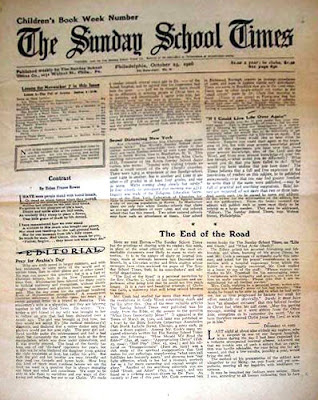
As Weak as a Sunday School


1926 Sunday School Paper

I have been re-reading the Christian classic In His Steps, by Charles Sheldon (1897). It was certainly one of the most influential books read in my high school years, and resulted in my choosing I Peter 2:21 as my life verse: "Christ suffered for you, leaving you an example, that you should follow in his steps."

In the book, one man who takes the challenge to always ask "What would Jesus do?" is a newspaper owner, who begins to transform his powerful paper into a Christian one. Of course he loses prestige, and money. As he recounts changes made after a few months he says, "Some say I will have a weak, namby-pamby Sunday School sheet. If I get out something as good as a Sunday-school it will be pretty good." He goes on to make a generalization that the Sunday school movement accomplished a lot of good, and wasn't weak at all.

I got to thinking about this, because many Christian endeavors are often characterized as weak, because they are genuinely meek instead. But I'm going to stick to the topic here of Sunday School. What has this movement really accomplished?

Its founding is credited to Robert Raikes and Thomas Stock in Gloucester, UK in 1780. It was established to educate and help children of the working poor, and was met with considerable criticism from those who didn't think the masses should be educated.

Facts
• Early on, it provided both spiritual and academic instruction, helping poor children prepare themselves for some life other than that of crime or hard labor.
• There is some evidence for Sunday Schools in America as early as the late 1600s.
• In 1824 the American Sunday School Union was formed and many schools were established. A notable example was the work of Stephen Paxon who founded 1314 schools in rural areas many of which grew into churches as the children matured.

Effects
• Children WERE educated. Remember that before 1870 children were not required to attend school in the United States.
• By 1889 American Sunday schools were performing the role of public education for 10 million children, sponsored and paid for by Christians
• some Marxist historians have credited 19th-century Sunday schools with empowering the working classes.
• Certainly SS classes have created generations of Christians with knowledge of the Bible. Consider that 500 years ago most people had never read a Bible passage for themselves.
• Sunday school provided a bright spot in the week when life, even for children, was usually dull and filled with work. Small toys, prizes, and interesting reading materials were coveted.
• Sunday School libraries often brought greater literacy to entire towns.

Sunday schools have fallen on hard times for a number of reasons, which are not the focus of this article.

The point is, if anything we can accomplish is as weak as Sunday School, we should be immensely satisfied, and certain that God has been glorified.

Tuesday, April 19, 2011

Today is an Empty Box


empty box with the word today on it

Talk about a message falling from the sky! You might think that I posed this picture, or doctored it, but I didn't. It literally fell from the sky.

A couple of days ago the winds were howling across our county- gusts up to 45 mph. The dog and I took a short walk anyway. Quite a lot of trash was sailing around our property, empty topsoil bags from somewhere, and other assorted scraps. One of them was this box.

This message is pretty trite, but the delivery was so unique that I was forced to pay attention.

Yes, today IS an empty box. Each of us is given a brand new chance, every morning, to fill our box with... good things, positive things, helpful things... or negativity, degrading images, laziness, hurtful things. We DO get to choose what we will put in that box.

If we fill it with garbage, the box will hide it for a while, until the odors seep into the cardboard and the whole box begins to stink, our "secret" will be out. If we fill it with fresh flowers, the beautiful scent will accompany us on our daily rounds.

If we put things in the box that don't belong there- perhaps some slimy mud, before long the box will begin to sag and lose its structure... its health. If we fill it with the kinds of things a box was designed to hold, it will serve us for many days.

If we think that we can ignore the box and put nothing in it, we have even made a choice. Before long, spiders and cockroaches and moths will come and begin to degrade the box until it's no longer useful.

What will I put in my box today? How about you?

Philippians 4:8
Finally, brothers and sisters, whatever is true, whatever is noble, whatever is right, whatever is pure, whatever is lovely, whatever is admirable—if anything is excellent or praiseworthy—think about such things.

Proverbs 23:7
for as [a person] thinks within himself, so he is

Sunday, April 3, 2011

Lyrics- Hiding Place

Every Sunday the lyrics from some great piece of Christian music will be featured. It's not that I want worship to revert to using all hymns, it's just that many modern Christian songs don't SAY anything. I really miss some deeper meaning. So I'm going to remind us of some great words.

Hiding Place
Jerry Dean Salley, Jr, Steven Curtis Chapman

In the distance I can see the storm clouds coming my way
And I need to find a shelter before it starts to rain
So I turn and run to You Lord, You're the only place to go
Where unfailing love surrounds me when I need it most.

Chorus:
You're my hiding place, safe in Your embrace
I'm protected from the storm that rages
When the waters rise, and I run to hide
Lord, in You I find my hiding place.

I'm not asking you to take away my troubles, Lord
'Cause it's through the stormy weather I learn to trust You more
And I thank You for Your promise I have come to know
Your unfailing love surrounds me when I need it most.
Chorus

So let your people seek You
While You may be found
'Cause You're our only refuge
When the rain comes pouring down
Chorus

This is attributed to Jerry Dean Salley, Jr and Steven Curtis Chapman with a date of 1997, but I learned the chorus in about 1988, so I don't know if the verses were added later. There is a very popular song with similar lyrics "You Are My Hiding Place" which seems to be the only one that videos were made for. I found exactly one video with this song, and it has no visuals except for the album cover. Just close your eyes and listen. This song became one of those that helped to hold us together through a very difficult time.


Monday, December 20, 2010

The Hound of Heaven


Francis Thompson
Francis Thompson

This post isn't going to be for everyone. Not many people will have the fortitude to read this entire poem, I'm pretty sure. But I was raised on a lot of famous poetry, and some phrases of this poem have been "hounding" me this fall.

I've been trying to deal with a big disappointment, where I believe that I was seriously wronged. To the point where I have considered taking legal action if I thought I could prove anything. Of course, this isn't the kind of person I want to be. I'm just trying to convey how upset and angry I've been.

Although this poem was written with the idea of God chasing down someone who has turned away from Him, it still resonates. Every time I felt so angry, I also felt that God's principles- the ones I want to live by- have been chasing me. For example:
From those strong Feet that followed, followed after.
     But with unhurrying chase,
     And unperturbèd pace,
     Deliberate speed, majestic instancy,
     They beat--and a Voice beat
     More instant than the Feet--
     "All things betray thee, who betrayest Me."

and

And now my heart is a broken fount,
Wherein tear-drippings stagnate, spilt down ever
     From the dank thoughts that shiver
Upon the sighful branches of my mind.
     Such is; what is to be?


So, I present to you the entire poem, The Hound of Heaven, by Francis Thompson, 1893. Read on, if you are brave:

I fled Him, down the nights and down the days;
I fled Him, down the arches of the years;
I fled Him, down the labyrinthine ways
Of my own mind; and in the mist of tears
I hid from Him, and under running laughter.
     Up vistaed hopes I sped;
     And shot, precipitated,
Adown Titanic glooms of chasmed fears,
From those strong Feet that followed, followed after.
     But with unhurrying chase,
     And unperturbèd pace,
     Deliberate speed, majestic instancy,
     They beat--and a Voice beat
     More instant than the Feet--
     "All things betray thee, who betrayest Me."

     I pleaded, outlaw-wise,
By many a hearted casement, curtained red,
Trellised with intertwining charities
(For, though I knew His love Who followed,
     Yet was I sore adread
Lest having Him, I must have naught beside);
But if one little casement parted wide,
The gust of His approach would clash it to.
Fear wist not to evade, as Love wist to pursue.
Across the margent of the world I fled,
And troubled the gold gateways of the stars,
Smiting for shelter on their clanged bars;
     Fretted to dulcet jars
And silvern chatter the pale ports o' the moon.
I said to dawn, Be sudden; to eve, Be soon;
With thy young skyey blossoms heap me over
     From this tremendous Lover!
Float thy vague veil about me, lest He see!
I tempted all His servitors, but to find
My own betrayal in their constancy,
In faith to Him their fickleness to me,
Their traitorous trueness, and their loyal deceit.
To all swift things for swiftness did I sue;
Clung to the whistling mane of every wind.
     But whether they swept, smoothly fleet,
     The long savannahs of the blue;
     Or whether, Thunder-driven,
     They clanged his chariot 'thwart a heaven
Plashy with flying lightnings round the spurn o' their feet--
     Still with unhurrying chase,
     And unperturbèd pace,
     Deliberate speed, majestic instancy,
     Came on the following Feet,
     And a Voice above their beat--
     "Naught shelters thee, who wilt not shelter Me."

I sought no more that after which I strayed
     In face of man or maid;
But still within the little children's eyes
     Seems something, something that replies;
They at least are for me, surely for me!
I turned me to them very wistfully;
But, just as their young eyes grew sudden fair
     With dawning answers there,
Their angel plucked them from me by the hair.
"Come then, ye other children, Nature's--share
With me," said I, "your delicate fellowship;
     Let me greet you lip to lip,
     Let me twine with you caresses,
     Wantoning
     With our Lady-Mother's vagrant tresses'
     Banqueting
     With her in her wind-walled palace,
     Underneath her azured daïs,
     Quaffing, as your taintless way is,
     From a chalice
Lucent-weeping out of the dayspring."
     So it was done;
I in their delicate fellowship was one--
Drew the bolt of Nature's secrecies.
     I knew all the swift importings
     On the wilful face of skies;
     I knew how the clouds arise
     Spumèd of the wild sea-snortings;
     All that's born or dies
     Rose and drooped with--made them shapers
Of mine own moods, or wailful or divine--
     With them joyed and was bereaven.
     I was heavy with the even,
     When she lit her glimmering tapers
     Round the day's dead sanctities.
     I laughed in the morning's eyes.
I triumphed and I saddened with all weather,
     Heaven and I wept together,
And its sweet tears were salt with mortal mine;
Against the red throb of its sunset-heart
     I laid my own to beat,
     And share commingling heat;
But not by that, by that, was eased my human smart.
In vain my tears were wet on Heaven's gray cheek.
For ah! we know not what each other says,
     These things and I; in sound I speak--
Their sound is but their stir, they speak by silences.
Nature, poor stepdame, cannot slake my drouth;
     Let her, if she would owe me,
Drop yon blue bosom-veil of sky, and show me
     The breasts of her tenderness;
Never did any milk of hers once bless
     My thirsting mouth.
     Nigh and nigh draws the chase,
     With unperturbèd pace,
     Deliberate speed, majestic instancy;
     And past those noisèd Feet
     A voice comes yet more fleet--
"Lo naught contents thee, who content'st not Me."

Naked I wait Thy love's uplifted stroke!
My harness piece by piece Thou hast hewn from me,
     And smitten me to my knee;
     I am defenseless utterly.
     I slept, methinks, and woke,
And, slowly gazing, find me stripped in sleep.
In the rash lustihead of my young powers,
     I shook the pillaring hours
And pulled my life upon me; grimed with smears,
I stand amid the dust o' the mounded years--
My mangled youth lies dead beneath the heap.
My days have crackled and gone up in smoke,
Have puffed and burst as sun-starts on a stream.
     Yea, faileth now even dream
The dreamer, and the lute the lutanist;
Even the linked fantasies, in whose blossomy twist
I swung the earth a trinket at my wrist,
Are yielding; cords of all too weak account
For earth with heavy griefs so overplussed.
     Ah! is Thy love indeed
A weed, albeit amaranthine weed,
Suffering no flowers except its own to mount?
     Ah! must--
     Designer infinite!--
Ah! must Thou char the wood ere Thou canst limn with it?
My freshness spent its wavering shower i' the dust;
And now my heart is a broken fount,
Wherein tear-drippings stagnate, spilt down ever
     From the dank thoughts that shiver
Upon the sighful branches of my mind.
     Such is; what is to be?
The pulp so bitter, how shall taste the rind?
I dimly guess what Time in mist confounds;
Yet ever and anon a trumpet sounds
From the hid battlements of Eternity;
Those shaken mists a space unsettle, then
Round the half-glimpsed turrets slowly wash again.
     But not ere him who summoneth
     I first have seen, enwound
With blooming robes, purpureal, cypress-crowned;
is name I know, and what his trumpet saith.
Whether man's heart or life it be which yields
     Thee harvest, must Thy harvest fields
     Be dunged with rotten death?

     Now of that long pursuit
     Comes on at hand the bruit;
     That Voice is round me like a bursting sea:
      "And is thy earth so marred,
     Shattered in shard on shard?
     Lo, all things fly thee, for thou fliest Me!
     Strange, piteous, futile thing,
Wherefore should any set thee love apart?
Seeing none but I makes much of naught," He said,
"And human love needs human meriting,
     How hast thou merited--
Of all man's clotted clay rhe dingiest clot?
     Alack, thou knowest not
How little worthy of any love thou art!
Whom wilt thou find to love ignoble thee
     Save Me, save only Me?
All which I took from thee I did but take,
     Not for thy harms.
But just that thou might'st seek it in my arms.
     All which thy child's mistake
Fancies as lost, I have stored for thee at home;
     Rise, clasp My hand, and come!"

Halts by me that footfall;
Is my gloom, after all,
Shade of His hand, outstreched caressingly?
"Ah, fondest, blindest, weakest,
I am He Whom thou seekest!
Thou dravest love from thee, who dravest Me."

Sunday, December 19, 2010

Lyrics- O Little Town of Bethlehem

Every Sunday the lyrics from some great piece of Christian music will be featured. It's not that I want worship to revert to using all hymns, it's just that many modern Christian songs don't SAY anything. I really miss some deeper meaning. So I'm going to remind us of some great words.

O Little Town of Bethlehem
Phill­ips Brooks, 1867

O little town of Bethlehem, how still we see thee lie!
Above thy deep and dreamless sleep the silent stars go by.
Yet in thy dark streets shineth the everlasting Light;
The hopes and fears of all the years are met in thee tonight.

For Christ is born of Mary, and gathered all above,
While mortals sleep, the angels keep their watch of wondering love.
O morning stars together, proclaim the holy birth,
And praises sing to God the King, and peace to men on earth!

How silently, how silently, the wondrous Gift is giv’n;
So God imparts to human hearts the blessings of His Heav’n.
No ear may hear His coming, but in this world of sin,
Where meek souls will receive Him still, the dear Christ enters in.

Where children pure and happy pray to the blessèd Child,
Where misery cries out to Thee, Son of the mother mild;
Where charity stands watching and faith holds wide the door,
The dark night wakes, the glory breaks, and Christmas comes once more.

O holy Child of Bethlehem, descend to us, we pray;
Cast out our sin, and enter in, be born in us today.
We hear the Christmas angels the great glad tidings tell;
O come to us, abide with us, our Lord Emmanuel!

This is the first American Christmas Carol. Phillips Brooks was inspired to write the words as he visited the Holy Land, and was looking down on the village of Bethlehem. For more about it's origins, see The Most Famous American Christmas Carol. I chose a version sung by Nat King Cole- another classic American favorite.


Saturday, December 18, 2010

The Christmas Story- Geneva Bible


A few years ago I was able to find an inexpensive copy of the Geneva Bible, published in 1560. This is the translation that the Pilgrims brought with them to the New World. I like to read familiar passages from less familiar translations. This often makes me think more about the words and their meanings.

You won't find this much different from the King James Bible, but I like it anyway. This is also my first entry in an occasional video series of Bible readings.

So, from someone known to be an old Scrooge when it comes to Christmas fol-de-rol, I invite you to contemplate the reason for Christmas, the celebration of Christ, in the first place.


Answer to Laddergram


Since Jesus was born in a stable, two likely visitors were SHEEP and DOVES.

The words of the laddergram are:
1. RAIDS
2. ARID
3. AIR
4. SHOOT
5. SOOT
6. SOT
7. EVENT
8. VENT
9. TEN
10. EERIE
11. EIRE
12. IRE
13. SLEEP
14. ELSE
15. EEL

Friday, December 17, 2010

Friday Fun - Laddergram


Are you familiar with Laddergrams? Answer the clues for each numbered space. Answer 2 is made from answer 1 with one letter removed, and the rest (usually) rearranged. Put the discarded letter in the left hand square. Answer 3 is made from answer 2 the same way. Put that discarded letter in the right hand square. Start over with clues 4-6, 7-9, etc. When you are done the discarded letters will vertically spell the answer to the puzzle.

Note that there is a clue that can help you solve the puzzle, too.

laddergram example

The clue for this puzzle is: Two likely visitors at Jesus' birth

laddergram

You can right click and choose view image to see the puzzle larger.

Monday, December 13, 2010

An Unexpected Lesson from the Garden


Jesus prays in the Garden

I know it’s not the Easter season, but I just thought of this lesson this week. We always are reminded that Jesus actually won the battle in the Garden of Gethsemane, when he submitted to the will of God, no matter how painful. His personal suffering is often used as an example of his humanity.

So, it occurred to me that it also illustrates the point that acceptance of difficult, even hurtful situations in our lives is a process.

Jesus knew what his mission was on earth. He knew what was the right thing to do. He wanted to do the right thing– had planned all along to do the right thing. And yet, when the reality of facing the cross was imminent, even Jesus had to go through a process of acceptance. He was sorrowful and troubled, and he wanted people (James and John) to be near him and share his burden in a small way.

Jesus may have known all along that in the end he would accept the terrible events he had to face, but he, our perfect example, couldn’t arrive at that point instantly.

Perhaps there is some physiological reason that the human body can’t (usually) immediately take bad news and leap into positive acceptance of it, no matter how spiritual a person may be.

We’ve been taught to recognize the stages of grief. We need friends to talk to when troubling things happen. And yet, we sometimes say to suffering people, “Get over it!”

Jesus, our perfect example, spent the difficult time in prayer. And yet, it took even God in human form several hours to reach the point where he could hold up his head and say, “I’m ready to face this.”

Now, there are those who insist on lingering in their sorrow, or refuse to move along the process of recovery. Some people refuse to accept the truth, or God’s will. We do need to be moving toward acceptance. We need to be seeking God’s will for our lives. This can take a while, in the face of major changes in our situation. And none of us are facing such a serious crisis as Jesus was.

But, we need to have patience with ourselves and others when troubling situations arise.

Perhaps when Jesus told the disciples, “The spirit is willing, but the flesh is weak,” he was speaking of his own flesh, as well as theirs.

Matthew 26

Saturday, December 11, 2010

Lyrics- Give Them All to Jesus

Every Sunday the lyrics from some great piece of Christian music will be featured. It's not that I want worship to revert to using all hymns, it's just that many modern Christian songs don't SAY anything. I really miss some deeper meaning. So I'm going to remind us of some great words.

Give Them All to Jesus
written by Phil Johnson and Bob Benson Sr., 1975

Are you tried of chasing pretty rainbows
Are you tired of spinning round and round
Wrap up all the shattered dreams of your life
And at the feet of Jesus lay them down

Chorus:
Give them all give them all give them all to Jesus
Shattered dreams wounded hearts broken toys
Give them all give them all give them all to Jesus
And He will turn your sorrow into joy

He never said you would only see sunshine
He never said there would be no rain
He only promised us a heart full of singing
At the very thing that once brought pain

There have been a number of times in my life when this song brought a lot of comfort to me. It was amazing how many terrible recordings of it are on YouTube. I found one with images that I thought really illustrated the song, but the vocal wasn't too good. I found a couple of professional voice recordings. But they really caused you to focus on the singer, and not the words. This one may too... but I appreciated the "real-ness" of this guy- this song is nothing if not real, where it hurts (and he can sing on key!).